If You've Tried Everything and You're Still Exhausted.
You don't have a discipline problem. You might be missing the one mineral stress steals first.
BY NOUSHA SALIMI · JUNE 2026 · 5 MIN READ
By the time most women find me, they've already tried the meditation apps. The adaptogenic lattes. The 6am workouts. The clean eating protocols. The therapy. The journaling.
And they're still exhausted. Still anxious. Still lying awake at 3am with their heart racing for no reason they can name.
The first thing I always tell them is this: you don't have a discipline problem. You might be missing something specific — something chronic stress has been quietly stealing from your body without you even knowing.
"Your body isn't burned out because you didn't try hard enough. It's burned out because it's been running on empty for too long."
What burnout actually does to your body
Burnout isn't just a mindset. It's a biological state. When your nervous system has been in fight-or-flight for long enough — weeks, months, sometimes years — it begins depleting the very nutrients that would help it regulate.
This creates a cycle that's almost impossible to think your way out of. More stress leads to more depletion. More depletion leads to more cortisol. More cortisol makes rest feel impossible. And without rest, the body cannot replenish what it's lost.
This is why no amount of positive thinking, willpower, or morning routines can fully break the cycle. Your nervous system isn't listening to your intentions. It's listening to your biology.
The three things stress steals first
These are the nutrients I check first with every woman I work with — because they are almost universally depleted in anyone living under chronic stress, and their absence makes regulation feel nearly impossible.
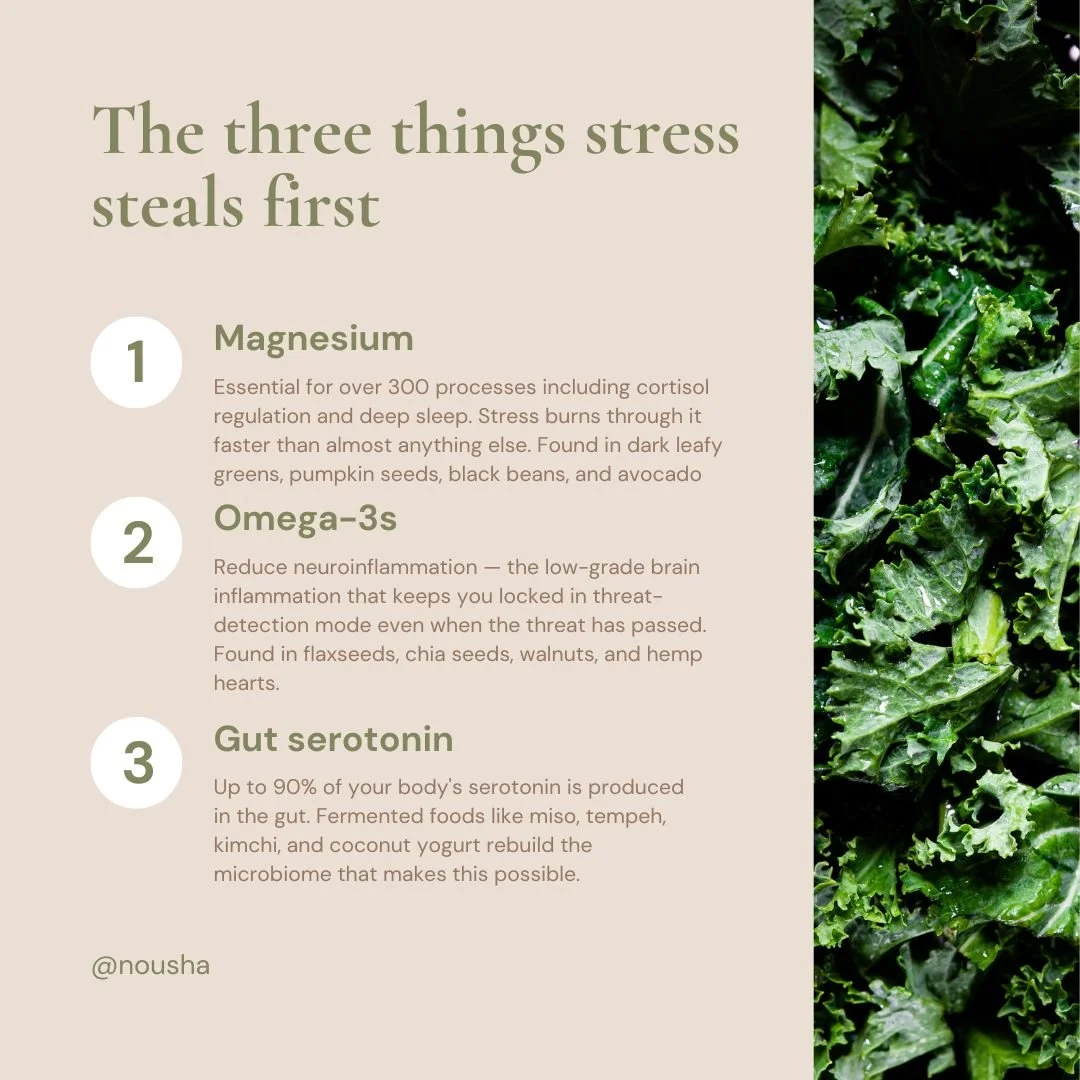
This isn't about being more disciplined with your diet. It's about understanding that your body has specific needs when it's been in survival mode — and that meeting those needs is not indulgent. It's necessary.
Why eating well isn't always enough
Here's something most nutrition advice misses entirely: it's not just about what you eat. It's about the state you're in when you eat it.
When you eat stressed, rushed, distracted — phone in hand, standing over the sink, eating between meetings — your digestive system is not a priority for your body. Blood flow is redirected. Stomach acid decreases. Enzyme production drops. Nutrient absorption slows dramatically.
This means you could be eating all the right foods and still not fully receiving them. The conditions around your meal matter as much as the meal itself.
Regulation begins before the first bite. A slow breath before you sit down. Phone face down. Thirty seconds to look at your food before you eat it. These are not soft suggestions. They are physiological interventions that shift your nervous system state before you've taken a single bite.
Stop adding more to your routine. Start asking what your body is actually missing. Burnout recovery isn't a mindset shift. It's a biological process. And food is one of the most direct levers you have.
We often approach anxiety as a problem to solve with the mind. But lasting regulation isn't just cognitive. It's physiological. It's built through hundreds of small moments that help the body experience safety, nourishment, and support.
Sometimes that begins with a breath. Sometimes it begins with a meal. Sometimes it begins with simply noticing how rushed you've become and choosing a different pace.
Not perfectly. Just consistently.
Because regulation doesn't start when you finally find the right thought. It starts when your body receives the message that it no longer has to stay on high alert.
If you've been running on empty for a long time, please hear this: your body is not broken. It is not failing you. It has been doing exactly what it was designed to do — keeping you safe under impossible conditions. And it needs specific things to find its way back.
Not more effort. More nourishment.